

We are all fond of the speed at which AI can compose writing, yet we do not want to lose the human touch, which makes reading content interesting and pleasant.
Several content creators already make use of AI-based tools, yet simultaneously, they fear authenticity. Readers desire to read something that is not fake.
You might be using AI writing tools to create drafts in just a few seconds. That is great for saving time. But raw AI content usually lacks personality and a unique voice that helps readers connect. This blog post will show you how to humanize AI-generated content so it feels natural and authentic.
By the end, you will know how to make AI content sound more human using a few AI writing tips in 2026.
What Is AI-Generated Content?
Developments such as GPT-4 AI models generate content by analyzing the trends in large volumes of data. Due to this, AI content is commonly applied in blogging, marketing, and SEO processes.
However, there is a serious drawback to AI content. AI cannot really perceive concepts as human beings do. It forecasts words on the basis of patterns, and this implies that the content is mostly a mix of what is already available on the internet.
It might be right, but not necessarily right. This is where humanizing AI content comes in. Humanizing refers to editing and bettering AI written text to give it personality.
Why Humanizing AI Content Is Essential?
It sounds like a lot of fun to write blog posts with the help of AI. However, on reading what is there, you will find something amiss. The text created by AI can be too formal, repetitive, or dead.
Let’s look at why humanizing AI content matters so much.
One big issue is accuracy. AI is capable of speaking with confidence even though it is telling false facts. Unless you fact-check, it may hurt your credibility. When you add real examples, data, or personal insights, your content becomes more reliable.
AI-written articles are often called generic or boring. AI-written articles can come across as bland, repeating the same phrases and sounding like a dry textbook. When readers get bored, they bounce. Adding qualities, simple vocabulary, and natural flow make your content more pleasing to read.
Most importantly, people connect with people. Using a conversational tone and a clear voice helps readers feel understood. This connection builds trust, which is essential for growing a blog and turning it into a source of income.
How to Humanize AI Content
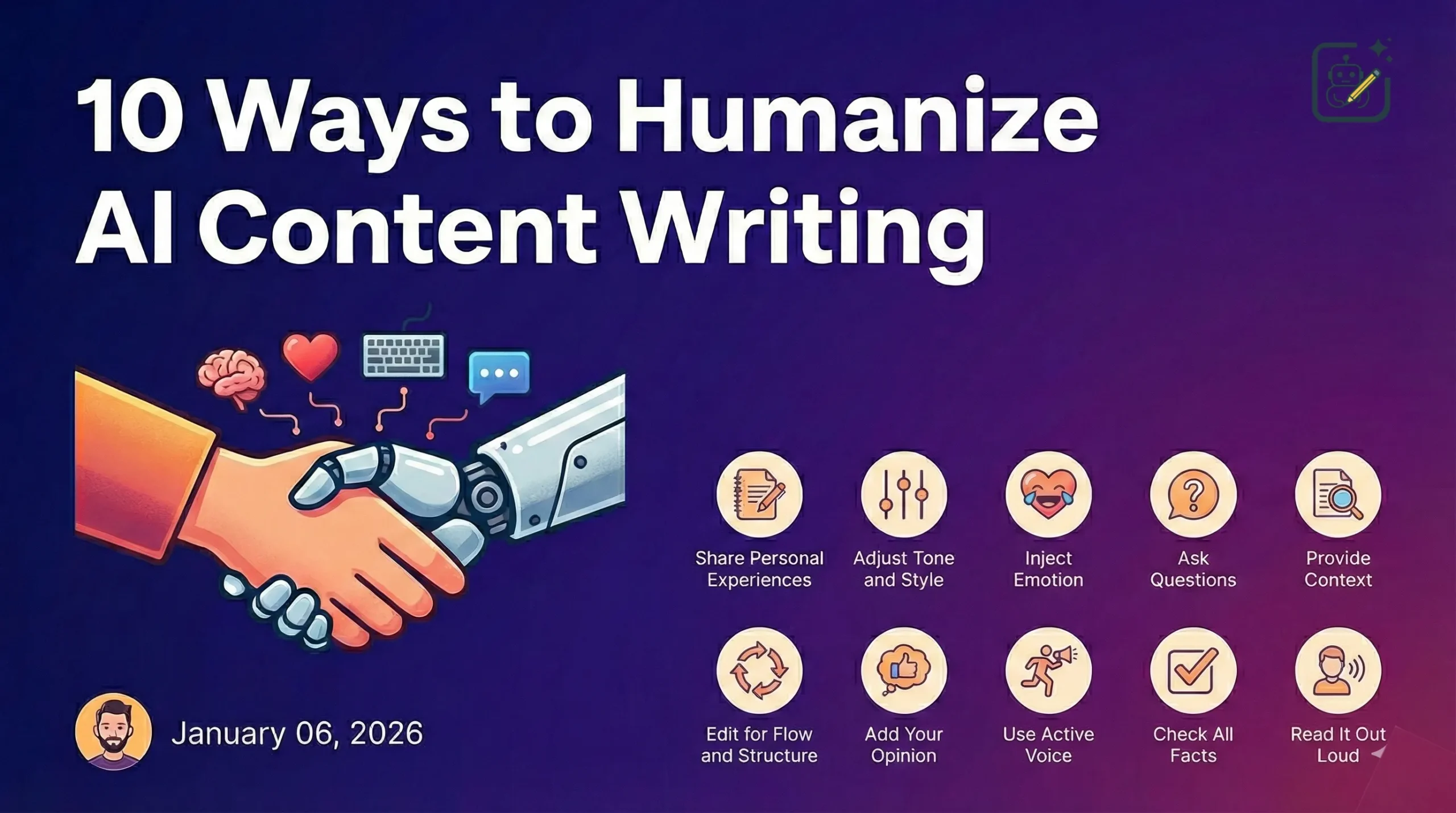
Below are proven ways to humanize AI content and make it connect better with real readers.
- Share Personal Experiences
Adding unique stories or real-life examples makes your content feel real and trustworthy.
For example, instead of saying, “This tool helps marketers,” try something like, “Last year, I used this tool for a client, and it helped double their website traffic.”
Small emotional details help readers relate to your content and feel like a real individual is speaking to them.
- Adjust Tone and Style
AI writing often sounds too formal or robotic. Change the tone to match your audience. If your readers are beginners, keep it friendly and simple. If they are professionals, stay clear but relaxed.
- Inject Emotion
AI does not feel emotions, but you do. Show excitement, curiosity, or even frustration by use of words when it is appropriate. Even a little will be a long way. Emotion keeps the interest of the readers and makes them feel that they are being involved in what they are reading.
- Ask Questions
Questions instantly make your content feel like a conversation.
For example, “Have you ever tried this tool and felt confused?”
This pulls readers in and makes them think. It also keeps them engaged instead of just scanning the page.
- Provide Context
AI often jumps straight to facts without explaining why they matter.
Add context by describing why something is vital or how it relates to everyday concerns. This can aid people who read through your work to have a more reasonable view of the issue and make your content more useful.
- Edit for Flow and Structure
AI content often uses sentences that all sound the same.
Go through the draft and mix things up. Use short sentences for impact and longer ones for explanation. Add smooth transitions between ideas.
Reading the content out loud is a great trick. If it sounds awkward, it probably needs editing.
- Add Your Opinion
AI does not have opinions, but you do. Sharing your thoughts makes the content original. For example, “In my opinion, this tool is overrated for beginners.” This adds personality and helps your content stand out from generic AI articles.
- Use Active Voice
Active voice makes writing clear and engaging. For example, instead of “Mistakes were made,” say “I made a mistake.” Active voice feels more direct, more personal, and easier to read.
- Check All Facts
AI sometimes makes things up. Always check numbers, claims, and quotes. In the case of the AI, provided it contains a statistic, verify it with a reputable source. Fact-checking creates trust and makes it clear to the readers that you are interested in the correct and honest delivery of information.
- Read It Out Loud
Human voice reading is among the most successful methods of humanizing the AI content. A sentence that is hard to pronounce will be hard to spell. Aloud reading will help you to remove the awkward phrasing, correct long sentences, and improve your tone.
What to Avoid When Humanizing AI Content?
When learning how to humanize AI content, it is just as important to know what not to do. Here are some common mistakes to watch out for:
- Avoid “Fake” Personality or Irrelevant Fluff
It is great to add personality, although in a real sense, and not to the topic out of place. Please do not impose jokes, slang, and memes that do not fit your audience. And go easy on emojis and exclamation points (!). Keep it human, but useful.
- Never Change Your Brand Voice.
Posting AI content humanized does not imply the loss of brand identity. You can still put some human touch on it, even when it is a formal or a technical tone, by letting things out in a very simple manner, sharing little personal experiences, or telling a very simple story.
- Do not attempt to say too much good.
The content of AI is usually too perfect or machine-like. It is okay when human beings commit minor errors. Don’t be too careful and cut out the natural flow of what you are writing.
- Don’t Ignore Feedback or Performance Data
Pay attention to how your content performs. Perhaps you should have more feeling in your content, or maybe it is too casual. Feedback is the way to optimize the connection between AI performance and human interaction.
Tools and Strategies That Help Humanize AI Content
Below are some useful tools you can add to your content strategy to make AI writing sound more human.
- Grammarly and Other Writing Assistants
Grammarly is not just a grammar tool. It also provides tone recommendations and indicates the sentences that sound strange or formal.
There are ProWritingAid, Hemingway, and Quillbot that assist with clarity, sentence construction, and word usage.
- AI Humanizer Tools
AI humanizer tools can help rewrite tricky sections that still sound robotic. However, always review the results carefully. These tools can sometimes change the meaning of your content. Use them as support, not a final solution.
You can also explore Generative Engine Optimization, which explains how better prompts and settings can improve AI content editing from the start.
- Hemingway Editor
The Hemingway Editor shows which sentences are hard to read and highlights too much passive voice. This tool helps simplify your writing, which is key when humanizing AI content.
Many people write too much when editing AI text. A simple rule is this: real humans explain complex ideas in simple ways, and Hemingway helps you do that.
- Tone and Style Settings in AI Platforms
Many AI writing tools let you pick a tone, like friendly, casual, or conversational. Some even train on their own writing samples for a custom vibe.
These options cut down editing big time. They are not flawless, but tone presets make your first draft feel way more human from the start.
- Content Optimization Tools
Tools like Surfer SEO, AI Write Tools, and Clearscope strike the perfect balance between SEO and readability. They recommend keywords, FAQs, and content gaps, without forcing robotic vibes. The result? Your humanized AI content ranks higher and reads naturally.
- Readability and Voice Checkers
Readability tools can catch tone issues you might miss. Hemingway, Microsoft Word’s Readability Stats, Google Docs’ insights, and sentiment tools all help check if your writing feels clear and balanced.
Even AI detection tools like GPTZero can help you review if your content still feels robotic or needs more emotion, personal stories, or empathy. For more tips, check out my other post on how to avoid AI detection.
Conclusion
Such measures will enable you to humanize AI content and describe it as something exciting and available to people. This contributes value to what you are writing, and this also assists in the creation of credibility and an authentic relationship with your readers.
Through this, it will fasten your content, and it will be efficient, and simultaneously, it will look like reality and human. It is the secret of sounding natural with the AI-generated text without losing your own peculiar voice.
FAQs
Is Google able to identify AI-generated content?
The text generated by AI can be monotonous or superficial to the human ear and thus unhealthy to your search rankings. This is why the AI content should be humanized when it comes to SEO.
How can I humanize AI content for free?
There are free tools such as Grammarly, aiwritetools, and Hemingway, which can be used to make the text more precise and less bold.
Are there tools that automatically humanize AI content?
Yes. The AI-written tools like QuillBot or even ChatGPT are able to paraphrase the text into more natural and smoother language.